
RSOLUTIONS official logoRSOLUTIONS
For people who have chased calm through achievements, purchases, and plans — and are still waiting

Inner peace: a practical path for people who live in the real world

You assumed peace would arrive after the promotion, the house, the sorted life. It did not, because peace is not a reward at the finish line — it is a relationship with what is happening now. That relationship has a practice, and the practice can start today.

AcceptanceLetting goForgivenessSimplificationValues alignmentEquanimity

From The Art of Inner Mastery — 8 Parts · 39 Chapters · Purchase completed on Google Play

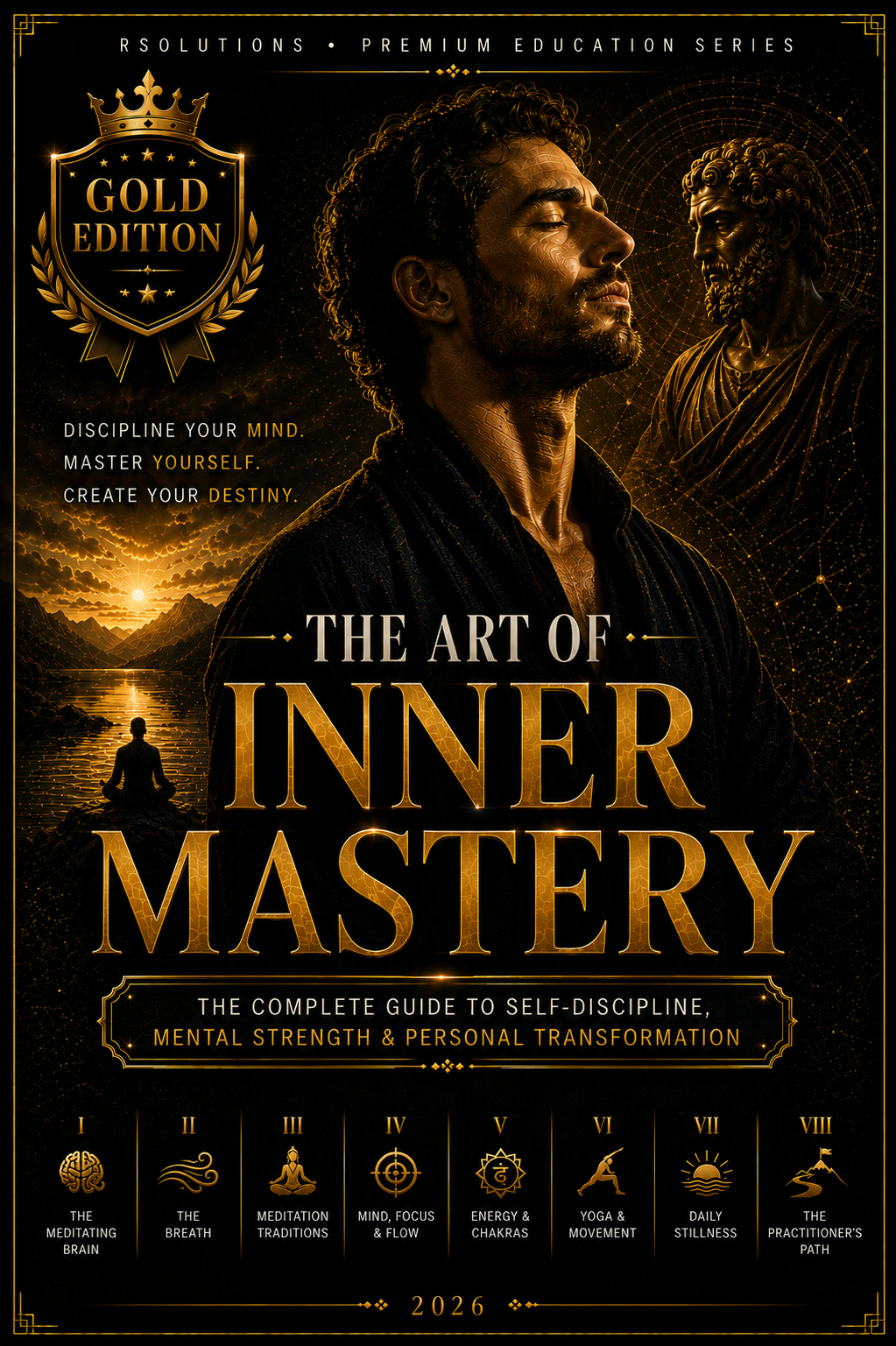
The Art of Inner Mastery book cover — Inner peace: a practical path for people who live in the real world Gold Edition
Mind won't stop racing?Stressed and can't switch off?Looking for inner peace?Want to finally learn meditation?Tired of living on edge?Ready to master your inner world?

This book teaches you how to master your inner world — for real. Meditation that sticks, breathwork that calms you in minutes, and emotional control you can train. Clear, practical, no mysticism required.

Is this you?

You have built a good life and cannot feel it.

Your mind treats every unresolved thing as an open wound to revisit.
You are at war with a past you cannot change and a future you cannot control.
Resentments you carry punish you more than anyone else.
Every achievement buys about a week of satisfaction.
Your life is full and your chest is tight.
You suspect peace is for other people — simpler people, luckier people.
The method

The architecture of peace: five practices, no monastery required

Acceptance: the end of the war with reality

Most inner turmoil is not caused by events but by the ongoing argument with events — the should-not-have-happened loop that replays what cannot be replayed. Acceptance is not approval and not resignation: it is ending the argument with what already is, so your energy returns to what can still be done.

The ancient dichotomy of control remains the sharpest tool ever built for this: your judgments, choices, and responses are yours; nearly everything else — outcomes, opinions, the past, other people — is not. Peace is what happens when you stop gripping the second category. The book turns this from philosophy into a daily sorting practice.

Letting go: of control, of the past, of the grip

Letting go is not one heroic release; it is a repeated unclenching. The practice: notice the grip (a controlled outcome, a replayed injury, an identity you have outgrown), name what holding it costs you today, and open the hand — again tomorrow, and again after that. Frequency, not force, is what dissolves the hold.

The past has one door worth using: extraction. Take the lesson, take even the strength the wound built, and leave the courtroom — the endless retrial where you play victim, prosecutor, and judge costs you the only time you actually own.

Forgiveness: dropping the hot coal

Resentment is the mind's most expensive tenant: it re-injures you with each replay while the other party lives rent-free, often unaware. Forgiveness — including of yourself — is not declaring the harm acceptable and not necessarily reconciliation; it is refusing to keep drinking the poison on someone else's behalf.

It is also a process, not a moment: acknowledge the harm fully, feel what it cost, decide to stop carrying it, and repeat the decision every time the mind picks the coal back up. Research links forgiveness practice with lower stress, better sleep, and improved mood — the body keeps score of grudges too.

Simplification and enough

A cluttered calendar, home, and feed produce a cluttered inner state — every object, obligation, and input is a small open tab. Strategic subtraction is a peace practice: fewer commitments kept better, fewer possessions actually used, fewer inputs actually digested. Peace loves margin.

Beneath simplification lives the deeper move: the 'enough' line. Without a defined enough, every finish line recedes as you approach it — the contentment treadmill that keeps achievers wealthy and restless. Define enough in the domains that matter, and gratitude for the present stops being a platitude and becomes arithmetic.

Alignment and equanimity: peace that survives contact

A large share of chronic unease is integrity gap: living at an angle to your own values — the job that contradicts them, the silence where honesty was owed, the yes that should have been no. Naming your top values and closing one gap at a time quiets an alarm that no relaxation technique can reach, because that alarm was correct.

The capstone is equanimity: the trained evenness that meets gain and loss, praise and blame, without being owned by either. It is built in meditation (watching experience arise and pass), tested in traffic and setbacks, and it is what makes peace portable — calm not because circumstances are calm, but because you are.

Note: This material is for general education and personal growth. It is not medical or psychological advice and does not replace professional care. If you experience persistent anxiety, depression, or other health concerns, please consult a qualified professional.
Action plan

The 7-step peace practice

1

Sort by control, daily

Each morning: what today is mine (choices, responses) and what is not (outcomes, opinions, the past). Energy goes only to column one.

2

End one argument with reality

Pick one should-have-been you keep replaying. Extract the lesson in writing, and formally close the case.

3

Practice the unclenching

Once a day, notice a grip — an outcome, a grievance — name its cost, open the hand. Repetition is the technique.

4

Start one forgiveness process

Choose the resentment that costs you most sleep. Acknowledge, feel, decide to stop carrying — and re-decide each relapse.

5

Subtract three things

One commitment, one category of clutter, one input channel — this week. Peace loves margin.

6

Define enough

Write your enough line for money, achievement, and possessions. Check the treadmill against it monthly.

7

Close one integrity gap

Name your top three values and the one place life contradicts them. Take a first step toward alignment — the alarm quiets fast.

Related searches this page answers

Built for the search you already made.

Core searches

how to find inner peace · peace of mind · how to be at peace · calm life · contentment

Acceptance

radical acceptance · accept what you cannot control · dichotomy of control · letting go · making peace with the past

Forgiveness

how to forgive · let go of resentment · holding grudges · self acceptance · self compassion

Living it

simplify your life · enough mentality · values aligned life · equanimity · gratitude practice

Get the complete system

This guide comes from The Art of Inner Mastery.

Everything on this page is one slice of the full book. Prices are Google Play listing references and may vary by region, taxes, and availability.

FAQ

Questions people ask about inner peace.

Is inner peace realistic in a stressful modern life?

Yes — because it depends on your relationship with events more than on events. The practices (acceptance, sorting by control, equanimity training) work precisely in busy, imperfect lives; monasteries are optional.

What is the difference between acceptance and giving up?

Giving up abandons the actionable; acceptance abandons only the argument with what already is. It frees energy for what can still be done — acceptance is the opposite of passivity done right.

How do I let go of the past?

Extract, then exit: take the lesson and the strength in writing, then close the courtroom. Letting go is a repeated unclenching, not a single act — expect to release the same grip many times, each one weaker.

Do I have to forgive people who genuinely wronged me?

Forgiveness is for your nervous system, not their record — it does not declare harm acceptable and does not require reconciliation or contact. It is refusing to keep re-injuring yourself with the replay. Take it at your own pace, with support if the wound is deep.

Why do achievements never bring lasting peace?

Adaptation: the mind normalizes each new level within weeks and moves the line. Without a defined 'enough', the finish keeps receding. Contentment is built from the enough line plus gratitude arithmetic, not from the next milestone.

Does minimalism actually help?

Subtraction helps to the degree that clutter — of calendar, home, and inputs — was keeping tabs open in your mind. The goal is margin, not aesthetic: fewer things held better.

What is equanimity?

Trained evenness in the face of ups and downs — feeling everything, being capsized by nothing. It is built through meditation and tested in daily friction, and it is what makes calm portable.

What if my restlessness is really an integrity gap?

Then no technique will silence it, because the alarm is accurate. Name the values being contradicted and close one gap; that unease is navigation, not noise.

Is this religious?

The sources span Stoic, Buddhist, and modern psychological traditions, but the practice here is secular: sorting, accepting, forgiving, simplifying, aligning. It runs inside any worldview.

Where is the complete path?

The Art of Inner Mastery assembles it end to end — meditation, breath, emotional mastery, and the peace practices — in Lite and Gold editions.

Final step

Peace was never at the finish line. It is a practice — and it starts now.

Sort by control, unclench, forgive, simplify, align. Ten minutes a day, and calm stops being a place you visit. The full path is in the book.