
RSOLUTIONS official logoRSOLUTIONS
For people who tried meditating once and concluded they are bad at it

Meditation for beginners: how to start (even if your mind never shuts up)

You sat down, closed your eyes, and your mind produced forty-seven thoughts in three minutes. Good news: that is not failing at meditation — that is meditation. The noticing is the rep. Here is how to actually start, and stay.

Step-by-step startRacing thoughtsBreath anchorDaily habitTypes comparedNo mysticism

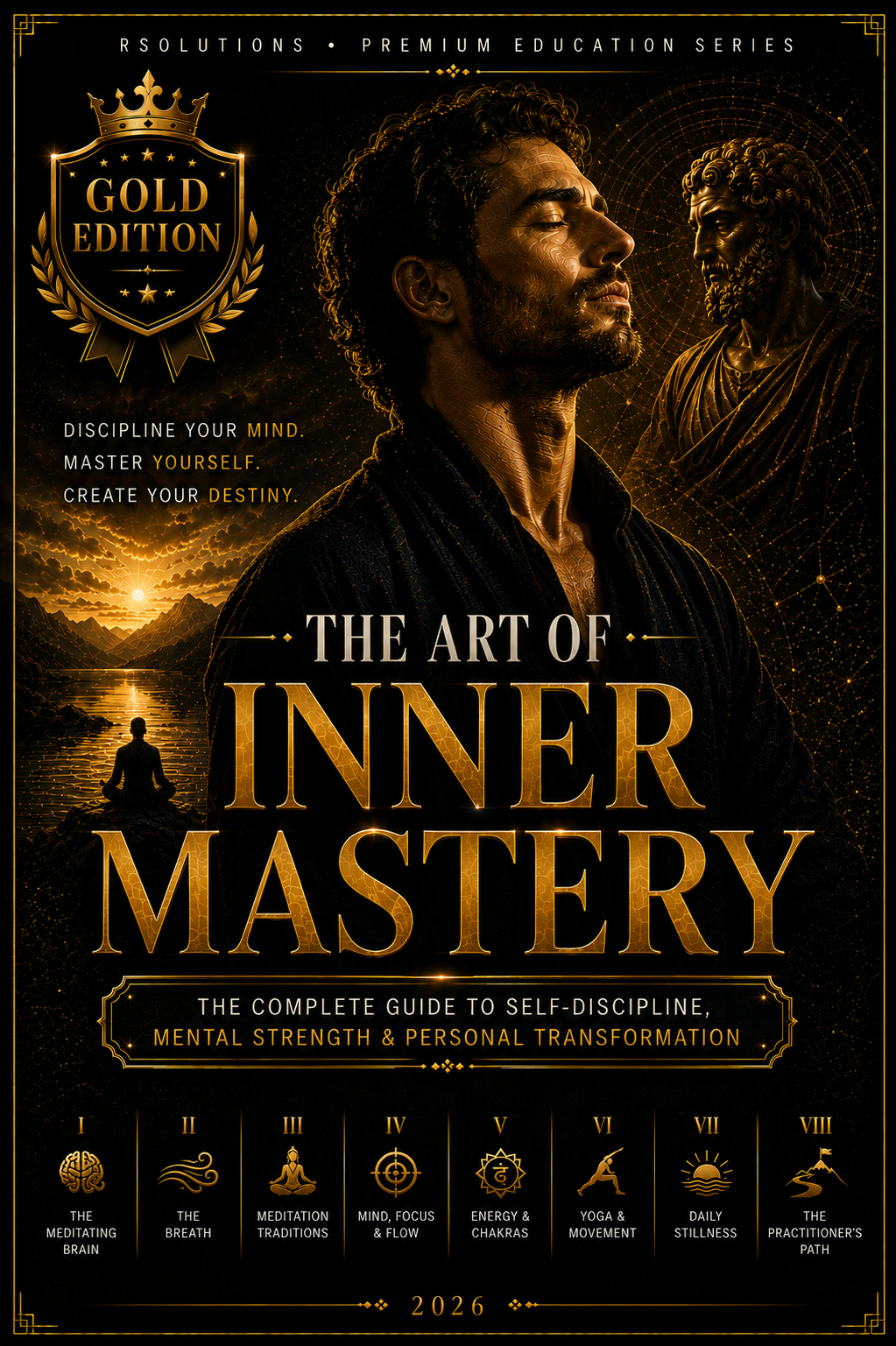
From The Art of Inner Mastery — 8 Parts · 39 Chapters · Purchase completed on Google Play

The Art of Inner Mastery book cover — Meditation for beginners: how to start (even if your mind never shuts up) Gold Edition
Mind won't stop racing?Stressed and can't switch off?Looking for inner peace?Want to finally learn meditation?Tired of living on edge?Ready to master your inner world?

This book teaches you how to master your inner world — for real. Meditation that sticks, breathwork that calms you in minutes, and emotional control you can train. Clear, practical, no mysticism required.

Is this you?

Everyone says meditate. Nobody explains what to do with the noise.

You cannot sit still for five minutes without reaching for the phone.
You tried an app, felt nothing, and quietly quit by day four.
Your mind produces more thoughts when you close your eyes, not fewer.
You suspect you are 'doing it wrong' but cannot say what right looks like.
Meditation content is either too mystical or too clinical for you.
You want the calm everyone describes and have never once touched it.
The method

How meditation actually works — and how to start today

What meditation is (and the myth that stops beginners)

Meditation is not emptying the mind — no functioning brain does that. It is attention training: you rest attention on an anchor (usually the breath), the mind wanders, you notice the wandering, and you return. That cycle — wander, notice, return — is not the failure. It is the entire exercise, the mental push-up itself.

The moment you understand this, frustration collapses. A session with fifty wanderings and fifty returns is fifty reps — a great workout, not a disaster. The busy mind you are ashamed of is the very reason the practice works on you.

The basic method, step by step

Sit comfortably — chair is fine, floor is fine, spine tall but not rigid, hands resting anywhere natural. Eyes closed or softly lowered. Take three slower breaths to arrive. Then let breathing be natural and rest your attention on its sensation: nostrils, chest, or belly — pick one station and stay.

When you notice you are lost in thought — planning, remembering, arguing — mark it gently ('thinking'), and walk attention back to the breath. No punishment, no commentary, no starting over. You return the way you would guide a puppy back to the path: firmly, kindly, a thousand times.

How long, how often: the honest dosage

Start with five minutes daily. Not twenty — five, every day, same time slot. Consistency builds the neural change; duration can grow later. Research shows measurable attention and stress-regulation shifts within about eight weeks of short daily practice — the sit does not need to feel profound to be working.

Anchor it to an existing routine (after coffee, before shower) and treat the two-minute bad-day version as fully valid. A daily five beats a weekly thirty by a mile — this is habit mechanics applied to mind training.

The main styles, translated

Breath-focused mindfulness is the foundational gym — start there. Body scan moves attention systematically through physical sensation and doubles as a sleep aid. Loving-kindness meditation trains warmth toward yourself and others, with solid research on mood. Mantra styles give the mind a syllable instead of the breath. Walking meditation anchors to footsteps — ideal for people who hate sitting.

They are equipment in the same gym, not competing religions. The book maps when each is useful; the beginner's answer is simply breath first, experiments later.

Guided or unguided, apps or not — and the plateau

Guided audio is training wheels: excellent for the first weeks, worth outgrowing eventually so silence becomes available to you anywhere. Apps help some people with structure and streaks; they are not required, and this book deliberately teaches app-independent practice.

Expect the arc: novelty, then a boring plateau around weeks two to six where 'nothing is happening'. That plateau is where the actual rewiring occurs — the practitioners who cross it are the ones who get the calm everyone else keeps reading about.

Note: This material is for general education and personal growth. It is not medical or psychological advice and does not replace professional care. If you experience persistent anxiety, depression, or other health concerns, please consult a qualified professional.
Action plan

Your first 30 days of meditation, in 7 steps

1

Pick the slot tonight

Attach five minutes to an existing daily anchor — after morning coffee is the classic. Same time, same place.

2

Set up in 30 seconds

Chair or cushion, tall relaxed spine, timer set, phone on airplane mode in another room.

3

Arrive with three breaths

Three deliberately slower breaths to mark the transition from doing to sitting.

4

Rest on one station

Choose nostrils, chest, or belly — and keep the same station all month. Depth beats variety.

5

Count the returns as wins

Every noticed wandering plus return is one rep. Fifty wanderings equals fifty reps, not fifty failures.

6

Never miss twice

Bad day? Do the two-minute version. The identity 'I meditate daily' is the asset being built.

7

Extend by feel, not force

When five minutes feels short — usually week three or four — grow to ten. Then hold there for a long while.

Related searches this page answers

Built for the search you already made.

Core searches

how to meditate · meditation for beginners · how to start meditating · am I meditating right · meditation step by step

Problems

racing thoughts meditation · mind wanders · can't sit still · meditation frustration · emptying the mind myth

Formats

breath meditation · body scan · loving kindness · walking meditation · guided vs unguided

Habit

how long to meditate · morning meditation · daily meditation habit · meditation consistency · 5 minute meditation

Get the complete system

This guide comes from The Art of Inner Mastery.

Everything on this page is one slice of the full book. Prices are Google Play listing references and may vary by region, taxes, and availability.

FAQ

Questions people ask about meditation for beginners.

Am I doing it wrong if my mind keeps wandering?

No — wandering and returning is the exercise itself. Each noticed wander is a completed rep. A 'noisy' session trains attention exactly as well as a quiet-feeling one.

How long should a beginner meditate?

Five minutes daily for the first weeks. Daily consistency drives the change; duration is secondary and can grow naturally when five starts feeling short.

What is the best time of day?

The time you will actually keep — for most people, morning before input floods in. Evening works too; sleepy after-dinner sits are the only slot that commonly fails.

Do I need an app?

No. Apps can help with structure early on, but the skill should eventually live in you, not in a subscription. This book teaches fully self-guided practice from day one.

How should I sit? Do I need the lotus position?

Any position with a tall, comfortable spine: a chair with feet flat is perfect. Lotus is cultural tradition, not a requirement — pain is not a sign of depth.

What are the proven benefits?

The strongest evidence covers attention control, stress reactivity, emotional regulation, and modest anxiety and mood improvements over weeks of practice. It is training, not magic — effects build like fitness does.

How long until I feel something?

Many notice slightly faster recovery from stress within two or three weeks; research commonly shows measurable change around eight weeks. Judge by your reactions in daily life, not by fireworks during the sit.

Is meditation religious?

It has roots in contemplative traditions, but the attention-training core is fully secular and is taught that way here. You can practice within any worldview or none.

What if meditation makes me anxious?

Short sits with eyes open and attention on sounds or the body can be gentler than deep interoceptive focus. If practice consistently intensifies distress, ease off and consider guidance from a professional — that is prudence, not failure.

Where do I learn the complete practice?

The Art of Inner Mastery builds the full path — posture, breath, obstacles, deepening stages, and the styles beyond — in Lite and Gold editions.

Final step

Five minutes tomorrow morning. That is the whole entry fee.

The calm you keep reading about is on the other side of a boring, repeated, five-minute sit. Learn the full method and start tomorrow.